Video: Four men accused
Four Rwandan men
living in Britain, including one given citizenship, appeared in
court yesterday accused of organising the mass slaughter of
Tutsis in the 1994 genocide.
|
|
|
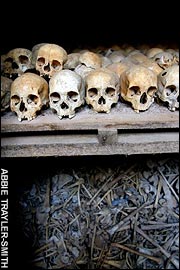
The four men are accused
of organising the mass slaughter of thousands of Tutsis
|
Vincent Bajinya,
who changed his name to Brown on becoming a citizen last year,
Charles Munyaneza, Celestin Ugirashebuja and Emmanuel Nteziryayo
face extradition. They were arrested after a deal under which
Rwanda becomes a temporary extradition partner with Britain.
Rwanda has waived the death penalty to secure their extradition.
In the first
case of its kind here, they are accused of orchestrating the
killing of "tens of thousands" of Tutsis. They exploited their
position as community leaders to set up militias, kill their
countrymen and incite mass murder during the 100-day genocide in
1994, City of Westminster magistrates were told.
Up to a million
people were killed when Hutu militias attacked Tutsis between
April and June 1994. The Rwandan government claims that the
four, who have been living throughout Britain for up to seven
years, played a key role.
Ugirashebuja was
refused asylum last year and Munyaneza had his refugee status
cancelled in September because it was obtained by deception, the
court heard. Miss Gemma Lindfield, representing Rwanda, said:
"They were the organisers and facilitators in the genocide."
Police believe
the men have links to a group of exiles that continued to spread
the ideology of Hutu ethnic supremacy, Miss Lindfield said.
Munyaneza had demanded a court translator "who was not Tutsi"
and had an anti-Tutsi document when arrested. She said police
believe all four had been in contact in England.
Munyaneza, a
48-year-old father of four living in Bedford, and Ugirashebuja,
53, from Walton-on-the-Naze, Essex, used their sweeping power as
local mayors – or bourgmestres – to set up killing militias,
Miss Lindfield said. Munyaneza, now a cleaner, toured Hutu
districts urging them to "wipe out" Tutsis. He also told Tutsis
in his Kinyamakara area to shelter in public buildings, knowing
they would be massacred.
"More than tens
of thousands were killed and as bourgmestre he was very much
responsible for the implementation and planning of those
killings."
Ugirashebuja
held a similar position in Kigoma, close to the capital Kigali.
"His role was to make sure that the Tutsis were being killed and
to monitor how many were being killed. . . he is responsible for
many thousands of Tutsi lives", Miss Lindfield said. Bajinya, a
45-year-old father of two who lives in housing association flats
in north London, and Nteziryayo, a 43-year-old father of five
living in Manchester, are also accused of mass killing. Bajinya
trained as a doctor, worked for a refugee charity in Britain and
served on a Government advisory committee. He arrived in 2000,
two years after his wife, Rosalie, and their son and daughter,
now 15 and 10. Miss Lindfield said that in Rugenge, a district
of Kigali, he "organised road blocks and ordered [the] militia
to kill people suspected of being Tutsi. . . he also led
militias to search houses [where Tutsis were hiding] and kill
them".
The allegations
against Nteziryayo were not read out because he did not apply
for bail. Reports have suggested he has been living on welfare
and is another former mayor of a district where many thousands
of Tutsis were killed.
The four deny
the accusation in a provisional extradition warrant which says
they killed Tutsis "with the intent to destroy in whole or in
part, that group". Rwandan authorities have 90 days to provide
evidence of a case to answer, which will be heard by a district
judge. The final extradition decision rests with the Home
Secretary.
Publishers
wishing to reproduce photographs on this page should phone 44
(0) 207 538 7505 or e-mail
syndication@telegraph.co.uk